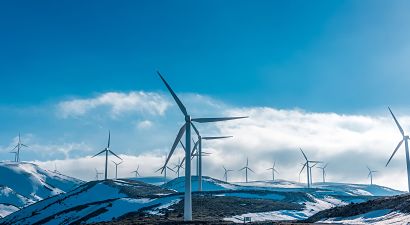
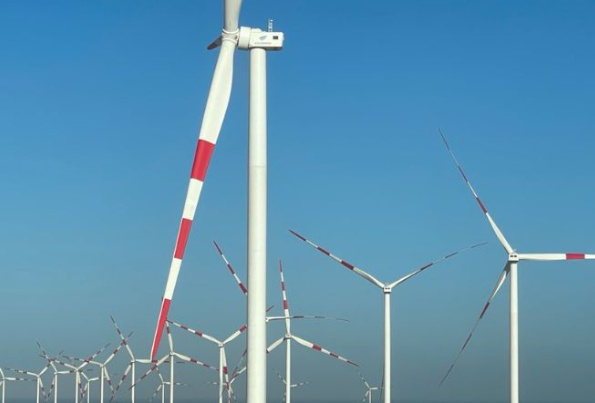
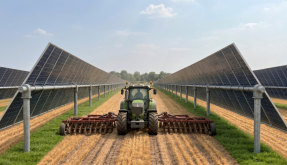
Around 66% of Kazakhstan’s territory has average wind speeds above 7 meters per second at 100 meters above ground, excellent for commercial wind projects. In comparison, less than a third of Germany has wind speeds above this level.
Ember tested the local weather data of 15 sites across Kazakhstan near demand centers and existing power lines, simulating the hourly output of 125 hybrid power plant configurations that combine different wind, solar, and battery capacity to evaluate their ability to meet a typical demand profile.
The results from the simulations, matching supply and demand hour by hour across a 30-year project lifetime, show that the country’s strong wind resources could provide an affordable source of electricity near demand. This could reduce the need for major new transmission lines to connect remote power plants to consumers.
By combining wind with solar and a small battery, these hybrid plants can provide electricity more consistently than wind alone. The modeling finds that hybrid plants can meet 70-90% of demand, depending on the site, at an average delivered cost of around $56/MWh – under $60/MWh at every site, lower than the cost of new coal power, estimated at $70-170/MWh.
Smartly operated hybrid plants can be a source of system flexibility
The simulations showed that the best-performing hybrid plants deliberately build more wind and solar capacity than can be absorbed by the demand profile every hour. Their generation cost averages $45/MWh, in line with Kazakhstan’s recent wind auctions. Delivering a reliable supply adds about $11/MWh, taking the average delivered cost to $56/MWh. That extra cost is the price of the surplus capacity that is curtailed in windy or sunny hours: it is a design choice made by the plant, and fundamentally different from grid-ordered curtailment without compensation.
At system level, a single project does not need to meet all demand with 100% reliability on its own. 70-90% is the most a single project can meet for under $60/MWh.The remaining 10-30% can be provided more efficiently by a more flexible, interconnected power system, which Kazakhstan has yet to build.
Kazakhstan’s electricity demand increased by 16% between 2020 and 2025, from 107.3 TWh to 124.6 TWh. The country has been a net electricity importer since 2022 and aims to achieve electricity self-sufficiency by 2027 and potentially become a net exporter by 2029. Coal accounted for 62% of electricity generation in 2025, and the country’s coal fleet is more than 50 years old on average.
Wind hybrid plants offer a unique opportunity to meet these challenges and by providing a way to build an affordable and reliable source of home-grown electricity quickly and at scale near to where demand is.
Kazakhstan has a target for renewables to supply 15% of electricity generation by 2030, but has no dedicated target for wind and solar beyond that date. The report recommends a clear target for wind and solar beyond 2030 that would give investors greater certainty and help Kazakhstan make better use of its wind resources. Market rules that reward flexibility would also help integrate more renewable electricity and make it a source of flexibility.