

Researchers from the Department of Energy’s Oak Ridge National Laboratory collaborated with the Eastern Band of Cherokee Indians (EBCI) to survey the Tribe’s lands, known as the Qualla Boundary, and determine whether micro-hydropower technologies could be a viable source of electricity for communities in remote pockets of the 83-square-mile tract. Micro-hydropower systems generate up to 100 kilowatts (kW) of energy by harnessing the natural flow of streams.
ORNL scientists and the Tribe used a combination of field work, hydrological modeling, data mining, machine learning, remote sensing and high-resolution satellite imagery to stitch together a finely detailed 3D map of the Qualla Boundary landscape. Using this as a guide, the team assessed the hydropower potential of more than 1,500 separate sites.
The findings demonstrate how advanced modeling and emerging energy technologies could strengthen energy resilience in the region on a broader scale.
“The Qualla Boundary is a microcosm of Southern Appalachia,” said Evin Carter, an ecologist and principal investigator at ORNL. “It captures the full range of conditions found across the region, from high-elevation, heavily forested mountain landscapes to lower-elevation community centers and developed areas. This allowed us to evaluate micro-hydropower across the full spectrum of settings where it could be deployed in Appalachia and, potentially, other mountain rural regions.”
The study also indicates that the placement of micro-hydropower devices at strategic sites within the Qualla Boundary could simultaneously generate power and improve aquatic habitats for fish and other wildlife in the area, which Carter described as a world biodiversity hotspot. With local economies and livelihoods dependent on these rivers, the researchers focused on areas that could meet the twin goals of reliable power and river stewardship, increasing the likelihood of implementation and community support.
ORNL researchers are exploring the technical potential of “hidden hydro,” in which emerging technologies can be used to tap into new sources of hydropower and contribute to a more secure, affordable and reliable energy supply.
The EBCI Tribe has about 15,000 members, and their community is located on a particularly craggy stretch of the Blue Ridge Mountain Range. A portion of the Qualla Boundary’s population is dispersed into areas where the ground is too uneven and steep to easily accommodate the installation of conventional electrical infrastructure.
Like other residents in rural Appalachia, some households in these remote spots may depend on diesel generators for electricity for extended periods due to severe weather or other grid impacts. Outages are frequent and long, even where electrical infrastructure does exist, because conditions make it difficult to maintain connectivity.
The EBCI has long sought to improve its members’ access to electricity. Though the Qualla Boundary is home to the Oconaluftee River basin — which has many fast-moving, well-fed waterways that could be harnessed to make energy — the Tribe has been reluctant to invest in conventional hydropower dams. The Tribe did not want to further segment its river system and possibly impede the movement of fish and other aquatic life.
“This project is assisting in assessing our full range of options to harness the energy available in natural Earth systems and contribute to long-term environmental and economic sustainability,” said Mike LaVoie, director of EBCI Natural Resources.
The investigation into micro-hydro as a possible solution grew from discussions between the Tribe’s Natural Resources Department and Carter in his capacity as the executive director of the Southern Appalachian Biosphere Cooperative, of which the EBCI is a member. Carter brings the strength of ORNL’s Water Power Program, which develops, evaluates and deploys new hydropower technologies.
One such technology is micro-hydropower. Carter and the EBCI considered two types of this technology: stand-alone micro-turbines and vortex generators. Vortex generators can produce up to 100 kW and are well suited for community-scale applications, such as clusters of homes or larger facilities like health centers or office buildings.
Micro-turbines generally produce more than 1 kW and are better suited to powering individual homes and small businesses. Both technologies are commercially available with water intake mechanisms designed to keep fish out of the turbines.
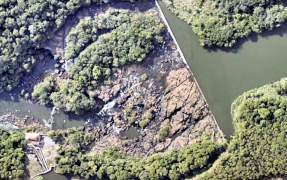
Carter and the EBCI researchers hypothesized that micro-hydro installations could be most productively deployed at locations where fish movement was most impeded by barriers. In this case, a “barrier” could be as big as a conventional hydropower installation, like the Ela Dam, or as simple as a culvert at a road crossing.
If the barrier was removed and replaced by a dam-less micro-hydro installation, the EBCI could achieve its two goals at once: more reliable, affordable energy and a more connected river system that supports fish and wildlife, recreation and local economies.
To test the theory, the team chose brook trout as a proxy species for its inquiry. Their widespread presence throughout the Oconaluftee basin, from the bottom lands to the highest mountain streams, defined the boundaries of the study area.
Next the team identified 1,533 potential barriers to fish movement in the study area using available datasets and Light Detection and Ranging, or LiDAR, imagery from the U.S. Geological Survey. Using hydrological modeling, researchers estimated the hydropower potential and aquatic restoration gains if those barriers were removed.
About 533 locations showed potential as possible micro-hydro sites. The study identified 366 sites capable of producing at least 2 kW, which is enough to support single-home micro-turbine systems, the most common development scenario. The study also found several sites above 3,900 feet in elevation that could produce more than 100 kW of hydropower generation, which exceeds the usual definition of micro-hydropower. This suggests that similar communities across Appalachia may benefit from micro-hydro development.
Researchers will now conduct field assessments at the most promising sites to refine generation estimates and identify locations for pilot demonstration projects. The Tribe and researchers will also conduct field surveys of brook trout to further guide restoration efforts.
This research was conducted as part of the Harnessing Ecosystem-Aligned Distributed Waterpower to Accelerate Transitions to Energy-Resilient Systems project, with support from DOE’s Hydropower and Hydrokinetic Office.
UT-Battelle manages ORNL for DOE’s Office of Science, the single largest supporter of basic research in the physical sciences in the United States. The Office of Science is working to address some of the most pressing challenges of our time. For more information, visit energy.gov/science.
— Clare Kennedy
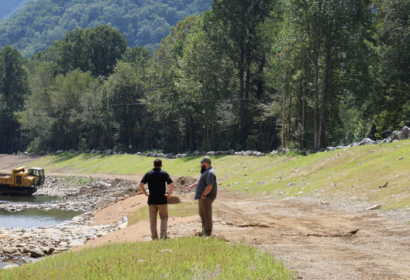
PHOTO: From left, Mike LaVoie, director of the Eastern Band of Cherokee Indians Natural Resources, and ORNL researcher Evin Carter discuss potential sites to add small hydropower devices to provide power to nearby homes and businesses in rural Appalachia.