
When the researchers pretreated sludge collected from a nearby wastewater facility, they produced 200% more renewable natural gas compared to current practices and reduced the final disposal cost by nearly 50%. Renewable natural gas could be used in the same way as fossil-fuel based natural gas for a wide variety of uses, including for electricity generation, home heating, or for transportation without the same climate effect as fossil fuels.
“This technology basically converts up to 80% of the sewage sludge into something valuable,” said Birgitte Ahring, corresponding author on the paper and a professor in WSU’s Bioproducts, Sciences, and Engineering Laboratory and the Gene and Linda Voiland School of Chemical Engineering and Bioengineering. “If we can replicate this work on other organic materials, we’ll have a waste treatment technology that is world-class when it comes to efficiency.”
Wastewater treatment facilities use large amounts of electricity to clean up municipal wastewater, making up between 3% and 4% of the total electricity demand in the U.S. They are often the largest user of electricity in a small community. Their treatment processes also contribute to global warming, adding about 21 million metric tons of greenhouse gases to the atmosphere annually.
About half of the approximately 15,000 wastewater treatment plants in the U.S. use anaerobic digestion to reduce sewage waste and make biogas, but the process, in which microbes break down the waste, is inefficient and struggles to break down all the complex molecules in the sludge. The biogas composed of carbon dioxide and methane has limited use, and the leftover sludge, called biosolids, most often ends up in landfills.
For their study, the Washington State University research team added a pretreatment step, treating the sludge at high temperature and pressure with oxygen added before the anaerobic digestion process. The small amount of oxygen under high-pressure conditions acts as a catalyst to break down the long polymer chains in the material. The researchers showed that their pretreatment resulted in reduced cost to treat the sewage from $494 to $253 per ton of dry solids.
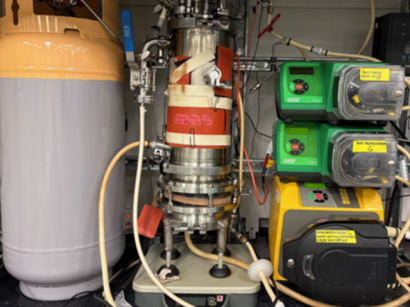
The team then used a novel bacterial strain that they discovered and isolated to upgrade the biogas, converting carbon dioxide with hydrogen into methane or renewable natural gas. The researchers analyzed and verified the renewable gas, showing that it was 99% pure methane.
“This (bacterial strain) bug doesn’t need anything — it is a workhorse,” said Ahring. “It doesn’t need organic additives or a lot of nursing. It does well with water and a vitamin pill.”
The researchers are working with WSU’s Office of Innovation and Entrepreneurship and have patented the bacterial strain. They are now working with an industrial partner to develop a larger scale project.
In addition to Ahring, the team on the project included researchers from Pacific Northwest National Laboratory, and Clean-Vantage LLC, a Richland-based clean technology start-up company. The work was funded by the U.S. Department of Energy Bioenergy Technologies Office.
PHOTO: As part of the project, the team used a novel bacterial strain to upgrade the biogas in a reactor, converting carbon dioxide with hydrogen into methane or renewable natural gas (photo courtesy of WSU).