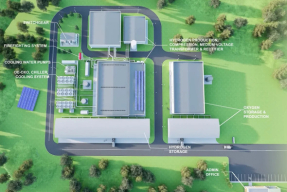

Once operational, the facility will process up to 50,000 tons of food waste each year, producing a recycled, nutrient-rich fertilizer product and enough green gas to power around 5,500 homes.
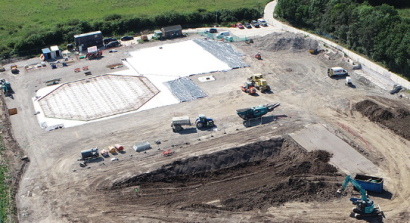
Principal contractor O’Brien Moran and Co. is now on site, with construction expected to take approximately 18 months. A period of testing and commissioning will follow before the facility becomes fully operational.
David O’Brien, MD of O’Brien Moran and Co. said, “OBM were delighted to be chosen by SUEZ as principal and civils contractor for this ambitious project. Working in close partnership with the SUEZ team and Stantec’s EPCM specialists, we are confident this collaboration will deliver a strong and successful outcome.”
With construction activity accounting for more than a third of global CO2 emissions, circularity has been central to the planning and delivery of the development by SUEZ. The careful dismantling of the previous on-site facilities enabled significant quantities of material to be retained and repurposed. More than 10,500 tons of concrete recovered during demolition is being re-used within the development’s formation layers, while approximately 60% of the structural steel required for the main building will be reclaimed.
The project will also incorporate biochar into the ground stabilization process. Biochar is a stable, carbon-rich material produced from biomass that can store carbon over the long term. Although it is widely used in agriculture and environmental remediation, its application at scale in construction materials and ground engineering remains relatively new, particularly in the UK. Approximately 115 tons of Arigna biochar will be used, helping to offset the embodied carbon associated with cement and ground engineering works.
The new facility will be powered by the existing onsite landfill gas power generation scheme, while also providing local energy security through the production of biogas.
The project is being delivered in line with the principles of Circularity in Practice, a nationwide, voluntary initiative of which SUEZ is a member. The initiative brings together a business-led, cross-sector taskforce to accelerate the adoption of proven circular solutions across the places where we live and work. It aims to turn widespread circularity from an ambition into practical action by promoting approaches such as designing out waste, prioritising re-use, high-quality recycling, remanufacturing and repurposing.
John Scanlon, Executive Vice President UK, SUEZ, said, “We are thrilled to have broken ground on this site, increasing food waste recycling capacity in the region alongside a source of reliable, renewable energy generation for local economies. Doing so in a sustainable way is the only way and I’m proud of the fact that we’re not only building with circularity in mind, but that we deconstructed the previous facility in this way too by repurposing buildings and re-using the materials.”
Michelle Pinggera, Chair of Circularity in Practice, said: “SUEZ consistently demonstrates innovation in its approach to circularity. It is particularly encouraging to see circular principles embedded in the planning and delivery of the facility itself, from the re-use of concrete and structural steel to the innovative application of biochar. These practical measures demonstrate how construction projects can reduce waste, retain the value of existing materials and lower embodied carbon. I look forward to seeing how this important project progresses.”