
For its monthly production reporting, Eco Wave Power focuses on periods in which wave heights exceed approximately 1 meter, as these conditions are considered particularly relevant to the performance parameters expected at the Company’s planned commercial-scale projects.
During April 2026, Jaffa Port experienced three days with wave heights ranging between approximately 1 and 1.5 meters. During these wave conditions, the power station generated approximately 461 kWh of clean electricity, with peak power production reaching 26.2 kW.
During May 2026, the site experienced four days with wave heights ranging between approximately 1 and 2 meters. During these conditions, the power station generated approximately 1,004 kWh of clean electricity-more than double the electricity generated during the comparable wave conditions reported for April. Peak power production reached 39.1 kW, while the station achieved an average power output of approximately 10.45 kW during the relevant operating periods.
Most of the electricity generated by the project is exported directly into Israel’s national electricity grid under a Power Purchase Agreement with the Israel Electric Corporation, while a portion is used for on-site self-consumption.
Higher Wave Conditions Demonstrate Increased Power Potential
The April and May results add to the growing body of real-world operational data generated by Eco Wave Power’s grid-connected technology under different sea conditions.
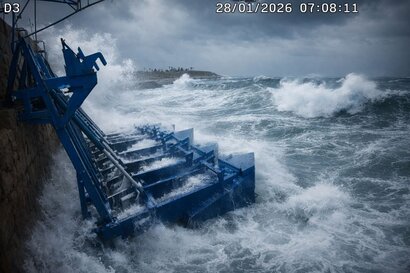
In February 2026, when wave heights reached approximately 3 meters, the Jaffa Port system achieved an average power output of approximately 20 kW, with peak power production reaching approximately 54 kW.
The results recorded to date demonstrate a progression in peak power output during increasingly energetic wave conditions:
April: waves of approximately 1-1.5 meters – peak power of 26.2 kW
May: waves of approximately 1-2 meters – peak power of 39.1 kW
February: waves reaching approximately 3 meters – peak power of approximately 54 kW
The Company believes this growing dataset provides valuable insight into the relationship between wave conditions and electricity production and supports continued optimization of the technology ahead of larger commercial deployments.
Continued Operational Reliability
Since the beginning of 2025, the Jaffa Port power station has maintained zero downtime attributable to the Eco Wave Power system, continuing to demonstrate the reliability of the Company’s onshore wave energy technology.
Eco Wave Power’s technology is designed so that the majority of the energy conversion equipment is installed on existing coastal infrastructure, while only the floaters interact directly with the waves. The Company believes this approach can provide advantages in accessibility, maintenance and scalability compared with technologies that locate the majority of their equipment offshore.
Pilot-Scale Validation Supporting Commercial Deployment
The EWP-EDF One project at Jaffa Port is a pilot-scale demonstration array, consisting of a limited number of small-scale floaters. The project is designed primarily to validate continuous operation, system durability and real-world energy production performance, while generating high-quality operational data to support future commercial-scale deployments.
The performance data collected to date further supports the Company’s ongoing evaluation of the scalability of Eco Wave Power’s proprietary technology. Future commercial projects are expected to utilize significantly larger floaters and a substantially greater number of units, configurations designed to increase energy capture and deliver a more powerful and stable production profile compared with the current pilot-scale installation.