
The project is a collaboration between researchers at the Hawaiʻi Natural Energy Institute (HNEI) in the University of Hawaiʻi (UH) at Mānoa School of Ocean and Earth Science and Technology (SOEST) and the National Laboratory of the Rockies (NLR), enabling this milestone in marine energy device deployment and testing.
“Projects like SURF-WEC work because different teams bring different expertise,” said Pat Cross, program manager for marine energy at HNEI. “NLR led much of the power take-off engineering, while we helped ensure a robust anchoring and deployment approach and supported testing here in Hawaiʻi. We learn from each other—and that collaboration is what makes projects like this successful.”
Decades of theoretical and modeling research have advanced the field of marine energy. But open-water deployment and testing of marine energy devices have been limited, leading to gaps in data and knowledge needed for commercialization. The deployment of SURF-WEC can help close these gaps: The device is expected to generate critical data the industry can build on.
“The marine energy community is so data starved,” said Bri Friedman, a NLR researcher on the project. “There’s just so few deployments that have occurred. And on top of that, a lot of those deployments don’t have accessible or shared data.”
To help fill that void, the researchers combined their expertise in wave modeling, controls, and ocean deployment to do something different: deploy a low-barrier, small-scale wave energy converter and provide open access to its design, data, and lessons learned.
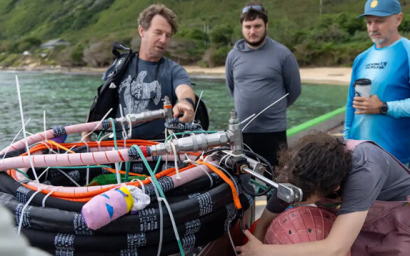
Born from earlier wave energy modeling work at NLR and an existing research flap developed by HNEI, the SURF-WEC turns wave motion into electricity. A buoyant flap anchored just offshore, roughly the size of a big-screen TV, oscillates back and forth with each passing wave—like a door swinging on its hinges. The movement of the flap from ocean waves drives a hydraulic system, which pumps fluid through a sealed system, building pressure over time. When a set pressure is reached, it is used to spin a motor connected to a generator, which produces electricity.
What makes SURF-WEC unique is its ability to adapt. Researchers can remotely adjust how the system responds to waves, testing both passive and active modes to better understand how to capture energy more efficiently.
Installed using just a small crew and a forklift, SURF-WEC will remain in the water for up to a year. Anyone can follow its progress via the live data feed. Funded by the Department of Energy’s Hydropower and Hydrokinetic Office, the project will culminate in a publicly available final report.